WASH in Educational and Healthcare Facilities Survey 2024
Publisher(s): Bangladesh Bureau of Statistics (BBS), UNICEF
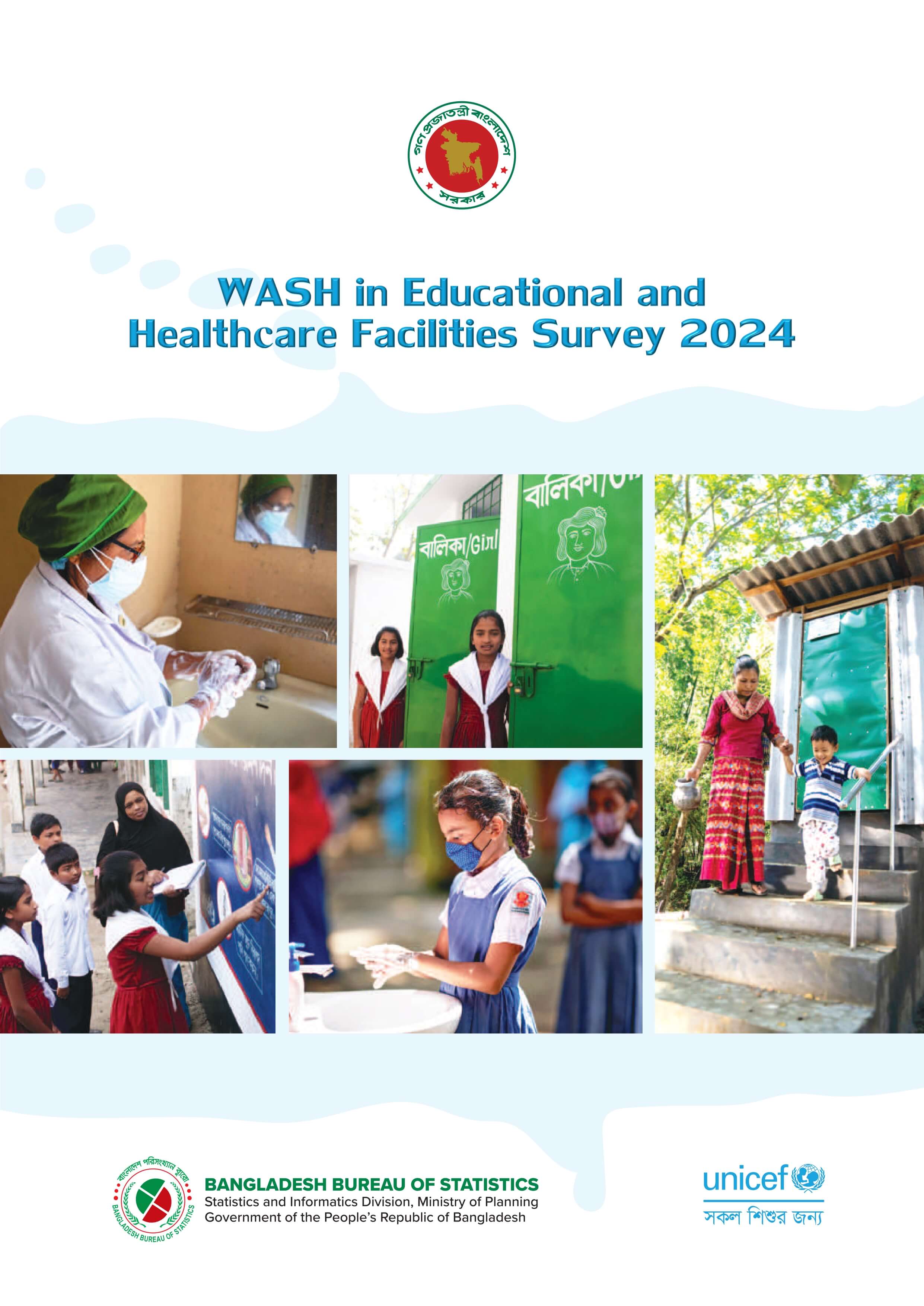
Category(s): Reports
Language: English
Publication Year: 2025
Document Type: PDF
Total Pages: 178
ISBN 13: 9789843586940
The Water, Sanitation, and Hygiene (WASH) in Education and Healthcare Facilities Survey 2024 provides a national assessment of WASH services across Educational and Healthcare Facilities in Bangladesh. Conducted by the Bangladesh Bureau of Statistics with technical support from UNICEF Bangladesh, the survey offers evidence to guide targeted improvements in infrastructure, service delivery, and policy implementation. Its findings support Bangladesh’s progress toward national development priorities and the Sustainable Development Goals, particularly those related to health, education, and equitable access to essential services.
Despite progress in expanding improved water and sanitation infrastructure, significant gaps remain. Many students, patients, and healthcare providers continue to be affected by inadequate WASH services, which compromise infection prevention and control in healthcare settings and hinder learning outcomes in schools. These gaps are most pronounced in rural, remote, and climate vulnerable areas where infrastructure quality, maintenance systems, and equitable access remain limited. The lack of inclusive and disability friendly WASH facilities continues to restrict participation for individuals with limited mobility and disproportionately affects girls and women.
The survey collected data from all eight divisions and 64 districts, covering public and private primary and secondary schools and a wide range of healthcare facilities. Sampling was guided by Watson’s formula to ensure representative data, and fieldwork was conducted from June 26 to July 17, 2024. The findings reveal substantial disparities across facility types, geographical regions, and managing authorities, highlighting areas where strengthened investment, improved governance, and targeted interventions are most urgently required. Access to improved water sources is high, at 95.4 percent in schools and 87.5 percent in healthcare facilities. However, fewer facilities meet the definition of basic water services, which requires the improved source to be available on the premises. Only 86.1 percent of schools and 70.5 percent of healthcare facilities meet this standard. Seasonal dry ups remain common in both sectors and often disrupt daily operations. Accessibility gaps are large, with only 55.4 percent of schools and 40.9 percent of healthcare facilities providing improved water points that are accessible to persons with disabilities. Limited financial provisions for maintenance, reported by only 11.1 percent of schools and 34.9 percent of healthcare facilities, further threaten the sustainability of existing systems.
Sanitation coverage is generally high, with 90.6 percent of schools and 98.5 percent of healthcare facilities having at least one toilet. However, quality and usability vary widely. Only 28.6 percent of schools meet the recommended standard of one improved toilet per 50 students, and the cleanliness of facilities remains a significant concern. Safe faecal sludge management is inadequate, with only 33.9 percent of schools and 45.4 percent of healthcare facilities managing excreta safely, raising risks of environmental contamination and disease transmission. Accessibility for people with limited mobility is particularly low at 4.6 percent in schools and 30.6 percent in healthcare facilities, indicating major barriers to equitable use.
Handwashing facilities are frequently present but often lack water and soap. As a result, only 51.7 percent of schools and 5.0 percent of healthcare facilities meet the criteria for basic handwashing services. This undermines effective hygiene practices and compromises infection prevention and control standards. Menstrual hygiene management (MHM) facilities remain insufficient, with only 20.7 percent of schools providing a private space for girls and only 6.9 percent offering basic MHM services. These gaps contribute to absenteeism, discomfort, and gender inequities in education.
Waste management practices vary. While 78.3 percent of schools report appropriate solid waste disposal, only 25.4 percent of healthcare facilities achieve basic healthcare waste management, xv WASH in Educational and Healthcare Facilities Survey 2024 which requires safe segregation, treatment, and disposal of hazardous waste. Reliance on site burning in 41.6 percent of healthcare facilities poses environmental and public health risks, indicating the need for improved infrastructure and safer disposal systems.
WASH systems in both sectors are highly vulnerable to natural hazards. Within the previous 12 months, 24.0 percent of schools and 19.4 percent of healthcare facilities experienced natural hazards, which caused direct damage to water and sanitation infrastructure in many cases. Despite this vulnerability, knowledge and implementation of climate resilient WASH measures remain low. Only 33.7 percent of schools and 9.9 percent of healthcare facilities report knowing protective measures, and even fewer have implemented them. This gap leaves facilities exposed to regular interruptions in essential services and limits their ability to withstand future climate shocks.
In summary, the survey identifies clear achievements in expanding basic WASH coverage, but it also reveals substantial gaps in reliability, quality, accessibility, climate resilience, and maintenance. Addressing these gaps will require sustained investment, strengthened capacity, and targeted actions focused on the regions and facility types most at risk. The evidence provided through this survey offers a pathway for prioritizing interventions that can significantly improve public health, educational outcomes, and resilience, supporting national progress toward universal and equitable WASH services for all.
Topic
Public Health
Focus Area
Hygiene, Sanitation, Water
Keywords
WASH, Bangladesh, UNICEF, BBS, Survey, Schools, Healthcare, Sanitation, Water, Hygiene, SDG, Statistics, Education, Facilities, Health, Waste
Country
Bangladesh
Copyright
This book or any portion thereof cannot be copied or microfilmed without the approval of the competent authority of BBS.
No comment yet.