Progress on household drinking water, sanitation and hygiene 2000-2024: special focus on inequalities
Publisher(s): JMP
Category(s): Reports
Language: English
Document Type: PDF
Brief summary
This data-driven JMP progress report presents global trends in household drinking water, sanitation, hygiene, and menstrual health from 2000 to 2024. It tracks progress toward SDG targets and highlights persistent inequalities across regions, income groups, and demographic characteristics. The report incorporates expanded datasets and new indicators, offering clearer insights into service disparities, fragile contexts, and menstrual health needs.
Report highlights
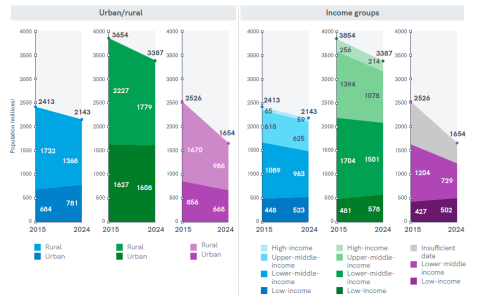
Between 2000 and 2024, the global population rose from 6.2 to 8.2 billion. Over this period, about a quarter of the population (2.2 billion) gained access to safely managed drinking water and a third (2.8 billion) to safely managed sanitation. Yet progress has been uneven and the number of people left behind has fallen more slowly. Since 2015, the distribution of the unserved has shifted: the proportion of the population with sanitation services has risen quickly in rural areas while staying relatively flat in urban areas. However, in terms of raw numbers most of the gains have been realized in urban areas. Basic hygiene access has improved, especially in rural areas; and the share of people unserved has increasingly concentrated in low-income countries.
-
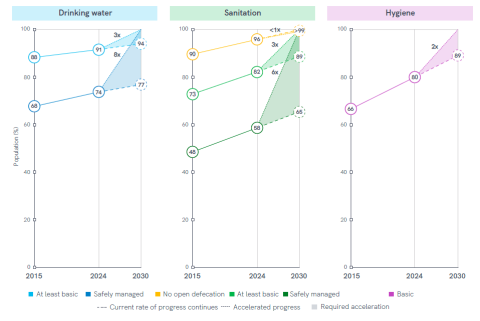
Achieving the 2030 targets for safely managed services is increasingly out of reach
1 of 4
-
The population without WASH services is declining except in urban areas and low-income countries
-
Inadequate access to drinking water
2.1 billion people still lack safely managed drinking water
Despite gains since 2015, 1 in 4 – or 2.1 billion people globally – still lack access to safely managed drinking water, including 106 million who drink directly from untreated surface sources.
-
Explore the interactive data portal
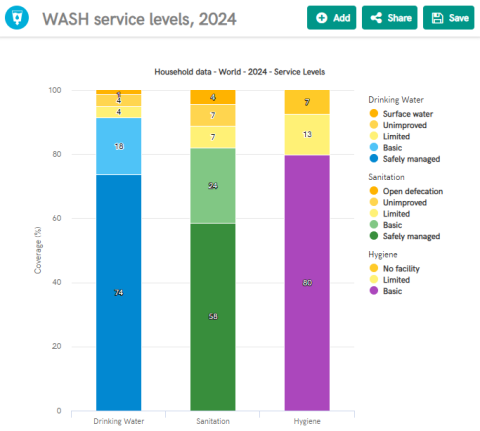
Create your own graphs, maps and tables with the JMP's interactive data portal
Report type
Monitoring category
Copyright
This is an open access work distributed under the terms of the Creative Commons Attribution License, which permits unrestricted use, distribution, and reproduction in any medium, provided the original work is properly cited.
No comment yet.